
Boating Lessons Learned: How a Navigation Lock Works
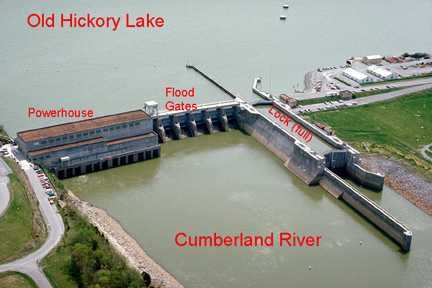
The lock is the river’s equivalent of an elevator that transfers a vessel from one side of a dam to the other. A lock consists of a concrete chamber with gates on either end. The size of the lock chamber varies from dam to dam but is typically 110 feet wide with lengths varying from 300 to 1000 feet.
Source: US Army Corps of Engineers, Nashville District
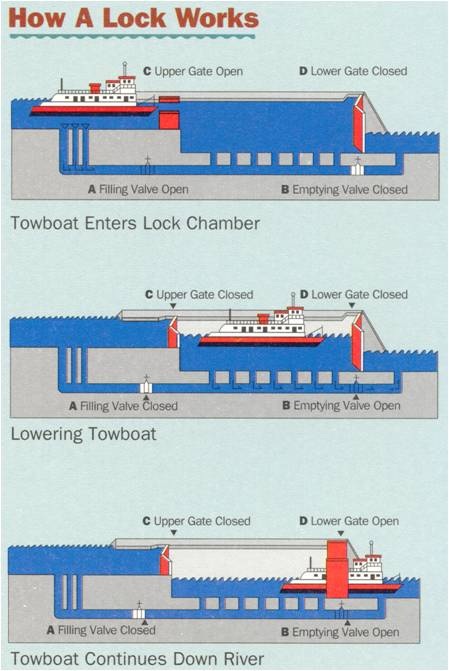
The lock chamber is filled and emptied of water by gravity and/or pump driven flow through a conduit system connecting the chamber to the upper and lower side of the dam. The conduits run under and along either one or both sides of the lock. They are large concrete tunnels with a cross section of approximately 12 feet square containing large valves that control the flow of water in and out of the chamber. The water flows up into the chamber through holes located below water level at the base of the lock wall like filling a bath tub from underneath.
Source: US Army Corps of Engineers
The lockage process begins with both gates closed. The lock operator opens the filling valve to allow water to enter the chamber. As the height of the water in the chamber approaches the height of the water above the dam, the water flow gradually slows down until the water levels equalize. The lock operator will then open the upper gate to allow the vessel to enter the lock. After the vessel is securely moored to floating moorings along the chamber wall, the operator will close the upper gate and open the emptying valve. The water is drained by gravity out of the chamber until the level of the water in the lock chamber equalizes with the level of the water below the dam. The lock operator will then open the lower gate allowing the vessel to exit the lock chamber. The process of filling and emptying the chamber will take between 30 and 40 minutes. Since the length of the lock is often too small to accept all the barges pushed by a towboat, the barge must splits into two or more sections. It may take 2½ hours or more to move a large towboat load through a typical lock.
I found an interesting simulator that allows the user to virtually operate a lock and get some sense of what goes on up in the lock operators control room. I apologize up front … for some reason it works on my Dell but not on my iPad but it is interesting so I figured I would share it anyway. Good luck.
For more information and to take a virtual tour you can visit this website maintained by the US Army Corps of Engineers, Nashville District.
OH. And thanks to all of you that have entered AMAZON
This post is for informational purposes only. Mcmanusboatworks.com makes no representations as to accuracy, completeness, currentness, suitability, or validity of any information on this site and will not be liable for any errors, omissions, or delays in this information or any losses, injuries, or damages arising from its display or use. All information is provided on an as-is basis.

 Shop Amazon Thanks to all of you that have entered Amazon through my site and made a purchase. It costs you no more and I make a small percentage that goes to defray the cost of operation.


 Boating Lessons Learned