
Boating Lessons Learned: Loose Wires
BLUF: When an engine is stalling intermittently from now on I will try cranking the engine and wiggling the wires to see if I can force it to stall. If it does then I my have found my problem.
I had forgotten this trick until yesterday when the local mechanic found the source of a problem that I had been attempting to solve for weeks. For me there is nothing more frustrating than an engine that runs great but stalls intermittently. How do I pin point the source of a problem when it comes and goes? Well I have to get lucky and catch it when it is in failure mode.
In this case the engine would run just fine when in the slip but if the owner took the boat out it would eventually die and not restart … at least not restart until he got the boat back in the slip. I first suspected that there was water in the tank and that when the boat was underway the rolling action caused the water to be sucked up and into the carburetor. Sure enough the fuel filter was full of mud colored water. The owner installed a new filter and ran the engine a few times checking and emptying the filter after each outing. But the intermittent stalling continued even after water was no longer showing up in the filter.
By this point the engine would often stall in the slip after only a minute or so of operation. When it would stall it sounded like it was running out of gas. It would spit and sputter and then die. Hum? Well it is not low on fuel. Maybe the float is sticking. This would allow the engine to start on the fuel that is in the bowl at start up but would eventually stall as the fuel in the bowl is used up. So I removed the flame arrester and pumped the accelerator pump a few time and sure enough … no fuel squirting means no fuel in the bowl. Well this engine sat unused for a number of years. Maybe the carb is varnished up on inside and this is causing the float needle to stick now and again. Seems reasonable. I checked the fuel pump and confirmed it was working and then removed the carb.
I love to rebuild carbs. The Holley is such a mechanical work of art. And the Carter’s that came on the old Chryslers were pretty nice too. But I hate Quadrajunk carbs. This is unfortunate because most marine gas engines are Chevy’s and most of them come equipped with a Quadrajet. So off to the carb man I went, Quadrajunk in tow and $160 later we had a nice and shiny part. The rebuilder reported that the carb was a mess inside. He was scheduled to have the rebuild complete in a couple of days but it was so gummed up that it had to soak in the cleaning solution for an extra day.
Yeah!!! We found the problem. Wrong!!! The engine did start and run great but on the first outing it stalled again when the owner attempted to bring the boat up on plane. Hum. More water in the tank? Maybe by tacking it up the water again sloshed around and was found by the fuel pick-up. This is getting old.
So after putting it off for a couple of weeks and after the generator started experiencing the same symptoms the owner decided to get his fuel tank pumped out. If water was the source of the problem this would eliminate it right away. If not then we can eliminate that possibility once and for all. And sure enough the tank had some water and trash in it but not that much. The mechanic moved on to the generator to see why it was not running. He pulled the fuel bowl off the generator carb and found that it was full of mud, same as the engine. Well clearly the contaminated fuel was a serious issue. But cleaning the tank and the carb bowl was the fix that the generator needed. The generator cranked and ran well afterwards.
But after all this work the engine was still spitting and sputtering and eventually stalling. After consulting with the boat yard owner the mechanic returned with another possible cause. Maybe it is a loose wiring connection? So he cranked the motor and proceeded to wiggle the wires to that engine. To his satisfaction when he wiggled the large wiring harness connector the engine died. Eureka!!!
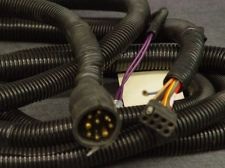
It seems that over the years the little pins inside the connector had expanded and contracted with the heat and had worked loose. He simply had to spread the male pins a bit so they would fit more snuggle into the female connector. Problem found. Problem solved.
Boating Lessons Learned: Wiggle the Wires.
This post is for informational purposes only. The content herein has a single theme: Mistakes …. or as I call them “Boating Lessons Learned”. While there may be elements of this site that appear to be advice about how to do some task you can be assured that it is not a complete and accurate “how to”. I am partially describing how I did something and what I learned. Do not rely on this information because Mcmanusboatworks.com makes no representations as to accuracy, completeness, correctness, suitability, or validity of any information on this site and is not liable for any errors, omissions, or delays in this information or any losses, injuries, or damages arising from its display or use. All information is provided on an as-is basis.

 Shop Amazon Thanks to all of you that have entered Amazon through my site and made a purchase. It costs you no more and I make a small percentage that goes to defray the cost of operation.


 Boating Lessons Learned